Birchwood League of Women Voters scrapbook: flap and sachet
A 1950s publicity scrapbook at the Minnesota Historical Society. A card is pasted along the top edge of the page, hangs down over a photograph, and is tucked into a pocket at its bottom. Lower on the page a second pocket holds foil sachets of Balm Argent hand lotion.
Drag up on the page, or use the slider. The card turns on its top hinge and foreshortens as it comes up. Keep pulling and a sachet slides out of its pocket and stops near the top of the page.
Drag up
Flap closedFlap upSachet out
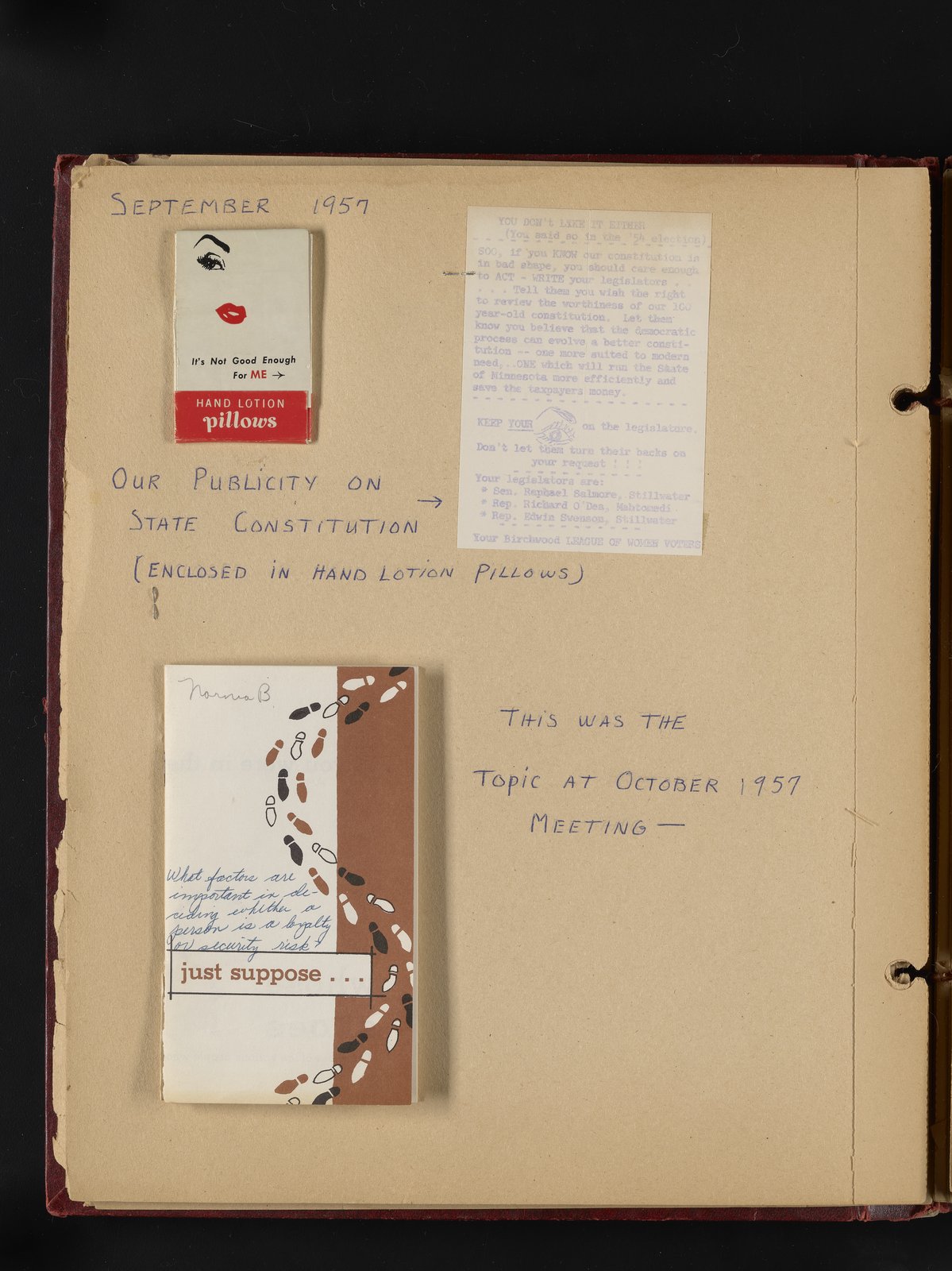
Flap closed.
What each photograph is
- 05 The starting point. Flap down, sachets in their pocket.
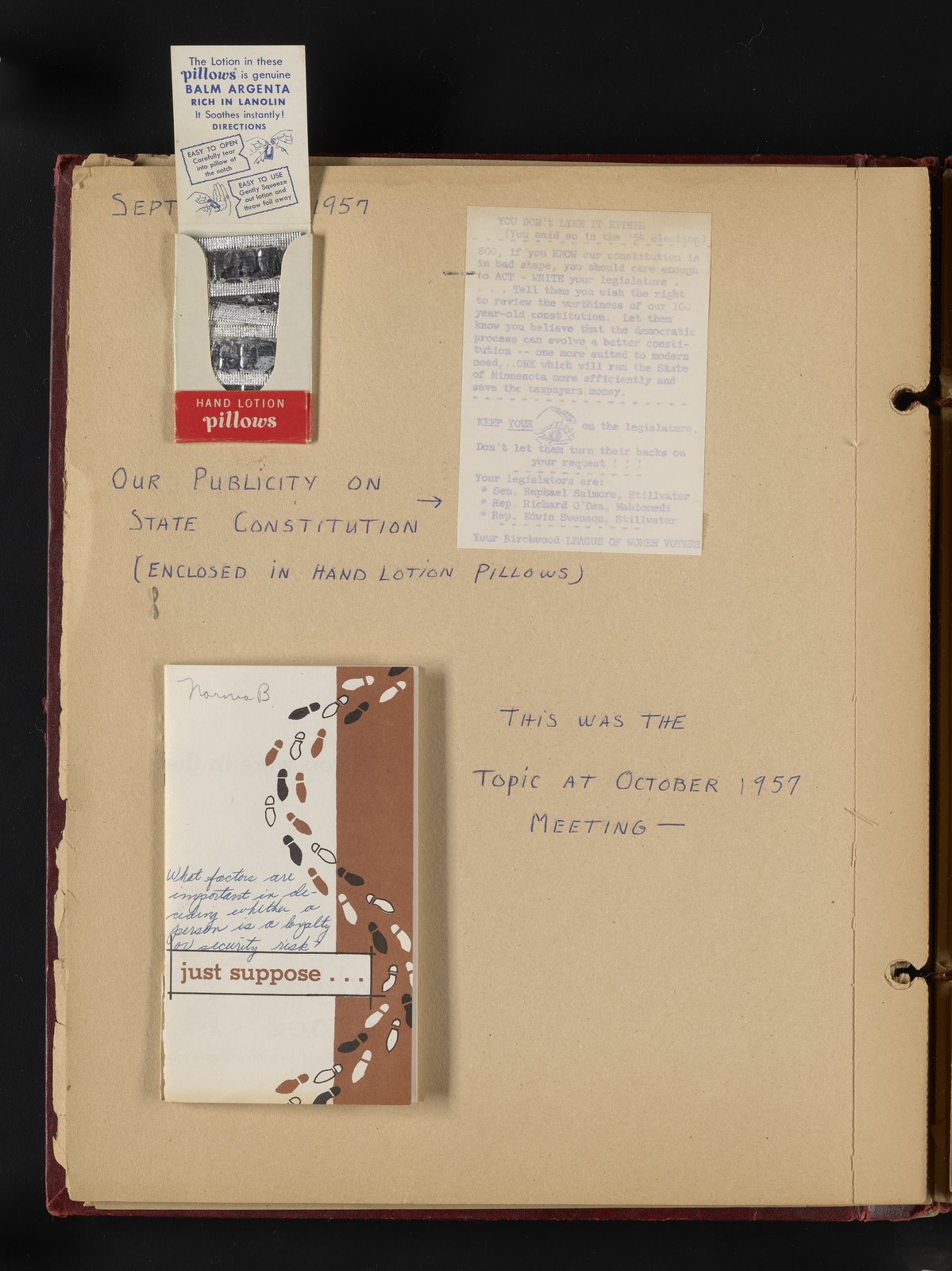
- 06 Flap folded up over the top edge. You get the inside of the flap, the photograph it was covering, and the sachets.
- 07 One sachet pulled up to the top of the page.
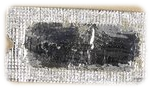
- 08 A sachet lying flat on the page. Not a state in the interaction; it is the frame the sachet cutout was trimmed from.
How this one is built
- Every layer is the same 1199×1600 scan, cropped with percentages. Nothing was re-exported except the sachet.
- The flap is one element with two faces and
transform-origin: top center. The recto is the 05 crop of the flap. The verso is the 06 crop of the folded-up flap, stretched to the flap's full height so the 3D foreshortening puts it back where the photograph has it. - The pocket layer sits between the base and the flap, so lifting the flap uncovers it.
- The sachet is a transparent PNG cut from 08. It pops in at the pocket mouth, because the real thing is hidden behind the paper edge until it moves, then slides out from under a strip of the base image so it stays tucked for the start of its travel.
Shooting this kind of object
- Tripod, and don't move it. Match exposure and white balance between frames or the layers shimmer where they meet.
- Photograph the flap partway up as well as open and closed. You need at least one frame with the flap out of the way to see what it covers.
- For anything that comes out of a pocket, shoot it in place, partway out, and fully out lying flat. The flat shot is the one you cut from.
- Keep the same crop and pixel size for every frame. Re-cropping between shots costs you the registration.
- The inside of a flap is the hardest frame to light, because the flap is in the way of the light. Expect to fix it in the crop.